
Leave A Message
If you are interested in our products and want to know more details,please leave a message here,we will reply you as soon as we can.

Glass laboratory vessels have been widely used for decades due to their transparency, availability, and chemical resistance in many applications. However, when experiments involve strong alkaline conditions, trace element analysis, or contamination-sensitive research, glass may introduce unexpected risks.
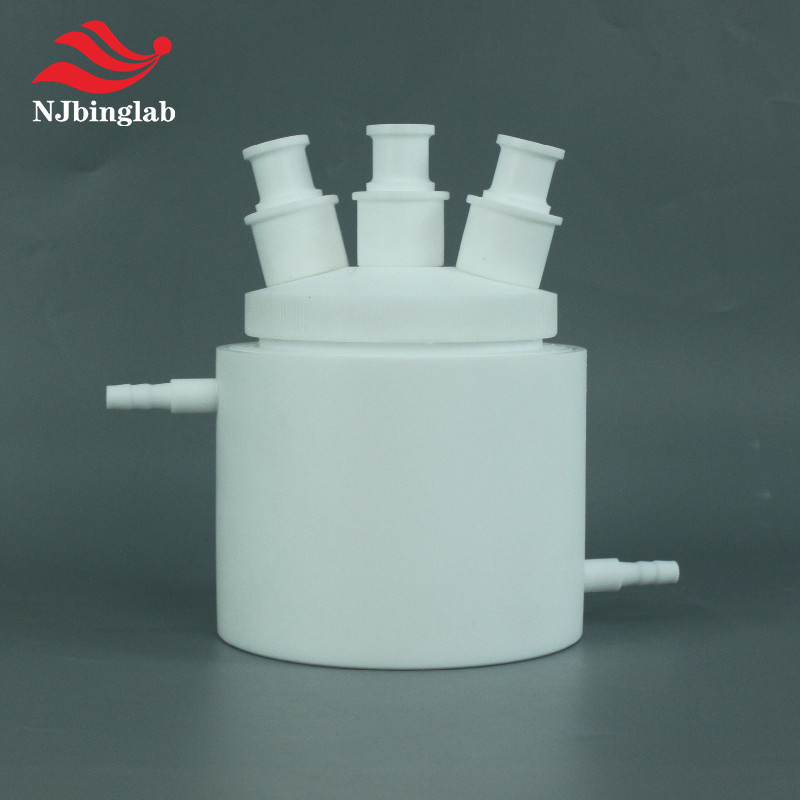
For researchers working with high-pH reactions (pH 12–14), switching from glass to PTFE reaction vessels can help minimize contamination and improve experimental reliability.
Glass is mainly composed of a silica-based network. Under highly alkaline environments, hydroxide ions can gradually attack the glass structure, causing partial dissolution and releasing soluble silicon species into the reaction system.
This effect may not be noticeable during conventional chemical reactions, but it can become significant in applications requiring:
Even low-level silicon contamination can affect analytical results, reaction pathways, or the interpretation of experimental data.
PTFE (Polytetrafluoroethylene) offers several advantages compared with conventional glass vessels:
PTFE is highly resistant to:
Unlike glass, PTFE does not contain a silica-based structure that can dissolve under alkaline conditions.
For experiments where elemental purity is critical, avoiding silicon-containing materials is essential.
PTFE vessels provide an inert reaction environment, helping researchers reduce contamination risks caused by vessel dissolution.
This makes PTFE especially suitable for:
Many chemical reactions require heating together with aggressive chemical environments.
PTFE reaction vessels provide:
Unlike standard glassware, PTFE reaction vessels can be customized according to experimental requirements, including:
This flexibility makes PTFE suitable for specialized research workflows.
Glass vs PTFE Reaction Vessels: A Practical Comparison
| Feature | Glass Vessel | PTFE Reaction Vessel |
|---|---|---|
| Strong alkaline resistance | Limited under long-term exposure | Excellent |
| Silicon contamination risk | Possible | Extremely low |
| Chemical inertness | Good for many applications | Excellent |
| Trace analysis suitability | Depends on application | Highly suitable |
| Customization | Limited | Flexible |
| Transparency | Excellent | Translucent |
When Should Researchers Consider Switching from Glass to PTFE?
PTFE reaction vessels are especially recommended when:
✔ The reaction occurs at pH 12–14
✔ Silicon contamination affects analytical results
✔ Trace element measurements are required
✔ The experiment involves high-purity materials
✔ Previous results show unexpected elemental interference
Glass remains an excellent material for many laboratory applications. However, for contamination-sensitive experiments under strong alkaline conditions, PTFE reaction vessels provide a more inert and reliable alternative.
By reducing silicon contamination risks and improving chemical compatibility, PTFE helps researchers obtain more accurate and reproducible experimental results.
Keywords:
PTFE reaction vessel, PTFE reactor, glass dissolution, silicon contamination, alkaline reaction vessel, chemical resistant laboratory vessel, trace element analysis, ICP-MS sample preparation
Leave A Message